How to Calculate Music Royalties for Independent Record Labels: A Practical Guide
A practical guide to music royalty calculations, artist revenue splits, distributor reports, recoupment, and royalty accounting for independent record labels.
Understanding streaming revenue, artist royalty splits, distributor statements, recoupment and professional royalty accounting.
Managing music royalties is one of the most important responsibilities of an independent record label. Every stream, digital download or licensed recording can generate financial information that must be processed, assigned to the correct rights holders and accounted for according to contractual agreements.
For a small label working with a handful of artists, this process may seem manageable at first. But what happens when the catalogue grows to hundreds of recordings, several artists, different royalty agreements and thousands of transactions in every reporting period? Manual accounting becomes increasingly complicated. Calculations take longer, financial information becomes harder to organise, and errors can damage the relationship between artists and labels.
Understanding how to calculate music royalties is therefore essential for anyone running an independent record label. In this guide we explain how royalty accounting works, how to process distributor reports, how artist revenue shares are calculated and how professional software can simplify the process. We also look at common accounting mistakes and practical ways to manage music royalties more efficiently.
All figures in this guide are hypothetical examples chosen to show the arithmetic. They are not taken from any real label, artist or customer.
What are music royalties?
Music royalties are payments connected with the licensed use or exploitation of music and the rights in it. They may arise from streaming, downloads, public performance, broadcasting, licensing and other uses.
Not all music royalties represent the same rights, however. One of the first things every record label should understand is the difference between sound recording royalties and composition royalties.
Sound recording royalties
Sound recording royalties relate to a particular recorded performance, often called the master recording. This revenue is generally associated with the recording's rights holders and with the commercial agreements under which the recording is distributed or licensed. Depending on the agreement, a record label may receive revenue from a distributor and then account to its artists.
Some uses of recordings are licensed and paid through collective bodies rather than through a distributor. In the United States, for example, SoundExchange explains in its FAQ how it collects and distributes digital performance royalties for sound recordings.
Publishing and composition royalties
Composition royalties arise from the underlying musical work: its music and lyrics. These rights are separate from the rights in the sound recording. Songwriters, publishers, collective management organisations and other parties may be involved in administering and receiving these payments.
Important: a record label should not automatically treat every royalty connected with a song as revenue that belongs to its recording catalogue.
Different rights may involve different owners, collection systems and contracts. Keeping these distinctions clear helps prevent incorrect calculations and double counting.
How do streaming royalties reach record labels?
When a listener streams a recording on a digital music service, the resulting revenue generally passes through a chain of contractual relationships. For recording royalties, the typical path looks like this:
- A listener plays a recording on a streaming platform.
- The streaming service calculates the amounts payable to the relevant recording rights holders under its licensing and allocation arrangements.
- The rights holder or its distribution partner receives the applicable revenue and the reporting information.
- A distributor may deduct its contractual fees.
- The record label receives its applicable share or balance.
- The label calculates the amounts owed to its artists according to their contracts.
- The label prepares statements and makes payments where they are due.
Actual payment flows vary with the parties and agreements involved.
Does Spotify pay a fixed amount per stream?
No. There is no universal fixed payment for every Spotify stream. Spotify explains that its royalties are allocated by streamshare, and the amounts that reach rights holders vary with factors such as the market, revenue and licensing arrangements.
This matters because a label cannot reliably calculate actual royalties by multiplying its number of Spotify streams by a single advertised per-stream rate. For accounting, the distributor's or rights holder's statements provide the financial information needed for reconciliation and for contractual royalty calculations. For more background, see the official Spotify for Artists royalties guide.
How to calculate artist royalties
The basic idea of a royalty calculation is simple: the label identifies the revenue base that applies and calculates the artist's contractual share of it. The actual calculation, however, must follow the terms of the relevant agreement.
For a simple contract in which the artist receives a percentage of net receipts, the formula may be:
Artist royalty = contractually defined net receipts × artist royalty percentage
The important words are contractually defined. Some agreements calculate royalties on net receipts, while others use a different base or include specific deductions and adjustments. A percentage alone does not explain the whole agreement.
Example: a simple 60/40 royalty split
Imagine that an independent label receives €1,000 of eligible net revenue from a distributor for one recording. The contract gives the artist 60% and the label 40%, with no further deductions and no outstanding recoupable balance.
| Step | Calculation | Amount |
|---|---|---|
| Eligible net revenue | Reported by the distributor | €1,000.00 |
| Label share | €1,000 × 40% | €400.00 |
| Artist royalty | €1,000 × 60% | €600.00 |
Under this simplified arrangement the artist is entitled to €600 and the label keeps €400. Real contracts may contain further provisions, deductions, adjustments or payment conditions.
Gross revenue vs. net revenue
One of the most common sources of confusion in royalty accounting is the difference between gross and net revenue. Both terms must be clearly defined in each agreement.
- Gross revenue generally means an amount before specified deductions.
- Net revenue means the amount left after the deductions defined by the reporting process or by the contract.
For example, imagine that a distributor reports the following:
| Description | Amount |
|---|---|
| Reported gross revenue | €1,200.00 |
| Distributor fee | −€180.00 |
| Amount received by the label | €1,020.00 |
If the artist's contract provides for 50% of the qualifying €1,020 of net receipts, and there are no other adjustments:
| Step | Calculation | Amount |
|---|---|---|
| Net receipts | €1,200 − €180 | €1,020.00 |
| Artist royalty | €1,020 × 50% | €510.00 |
The artist's calculated royalty would be €510. If the contract defines the royalty base differently, the correct amount may change. This is why royalty accounting must be connected to the actual contract terms rather than to generic percentages.
The label should also avoid subtracting the same distributor fee twice when the statement already reports revenue after that fee.
Understanding artist advances and recoupment
Some recording agreements include advances or other costs that can be recouped under the contract. An advance is generally an amount paid before the artist has earned enough royalties to cover it. If the agreement allows recoupment, qualifying royalties may be applied against the outstanding advance before any further payment becomes due.
A practical recoupment example
Assume that the artist's calculated royalty for the period is €600, the outstanding recoupable advance is €250, the contract allows the full €250 to be recouped from this royalty, and no other deductions or restrictions apply.
| Item | Calculation | Amount |
|---|---|---|
| Royalties earned this period | Contract share | €600.00 |
| Advance recovered | Outstanding balance €250 | −€250.00 |
| Remaining advance balance | €250 − €250 | €0.00 |
| Payable to the artist | €600 − €250 | €350.00 |
The artist has earned €600, but €250 of it recovers an advance that was paid earlier. These amounts must be shown separately in the royalty records. A recouped advance should not be confused with an ordinary service fee or an unrelated business expense.
Why recoupment tracking matters
A label that manages several artists with different advances must track the outstanding balance for each agreement accurately. The accounting may also need to consider:
- Which costs are recoupable.
- Whether recoupment applies to one release or to several.
- Whether the contracts allow cross-collateralisation.
- How earlier royalty periods affect current balances.
- Whether corrections or adjustments change the amount available for recoupment.
Incorrect recoupment calculations lead to inaccurate statements and to disputes with artists.
How to process music distributor royalty reports
Most record labels receive financial reports from distributors or other revenue partners. These usually arrive as CSV, Excel or other structured data files and, depending on the provider, can contain thousands or even millions of transaction lines. Typical fields include:
| Field | Purpose |
|---|---|
| Reporting period | Identifies the accounting period |
| Store or DSP | Identifies the source of the revenue |
| Artist | Names the associated artist |
| Track title | Identifies the recording |
| ISRC | Identifies a specific sound recording |
| Territory | Identifies the reported country or market |
| Usage quantity | Reports streams, downloads or other units |
| Revenue | Contains the financial amount |
| Currency | Identifies the currency of the amount |
Some providers supply further financial or technical fields. A dependable workflow for each report has seven steps.
Step 1: Preserve the original report
Keep the original distributor statement available for reconciliation and review. Avoid editing the source file by hand and losing the original transaction information.
Step 2: Validate the data
Check for invalid rows, unexpected values, missing recording identifiers, duplicate imports and inconsistent formatting. Not every provider exports reports with the same column names or structure.
Step 3: Match recordings
Associate each transaction with the correct recording, artist and agreement. ISRCs are particularly useful when they are present and accurate. Lines that do not match should be reviewed, not assigned arbitrarily.
Step 4: Handle currencies
International streaming and distribution reports may contain different currencies. If conversion is necessary, use appropriate, documented exchange rates and accounting rules, and keep a clear record of how each amount was converted.
Step 5: Apply the royalty calculations
Calculate each artist's contractual share using the correct revenue base and any conditions specific to the contract.
Step 6: Reconcile the totals
Compare the imported and calculated figures with the statements and the receipts you recorded. Investigate any discrepancy you cannot explain.
Step 7: Prepare artist statements
Once the reporting period has been validated, prepare statements that show the relevant revenue, calculations, deductions and balances. This workflow becomes more demanding as the number of recordings, artists, contracts and transactions grows.
What should an artist royalty statement include?
An artist royalty statement should be clear enough for the recipient to understand how their royalties were calculated. Depending on the contract and the reporting requirements, useful information includes:
- The record label's name.
- The artist's or payee's name.
- The accounting period.
- The recordings or catalogue information concerned.
- The sources of revenue.
- The reported earnings.
- The contractual royalty percentage.
- Deductions and adjustments that apply.
- Recoupable balances, where relevant.
- The total royalties calculated.
- Payments already recorded.
- The amount now payable, or the balance carried forward.
The statement should distinguish between money earned, money already paid and money still owed. An effective statement is not simply a final number: it is a financial explanation.
Why statement transparency is important
Independent artists rely on clear information to understand how their recordings are performing financially. Well-organised statements make it easier to find discrepancies, answer questions and keep professional relationships healthy. For labels, transparent reporting also cuts the time spent explaining the same calculations again and again.
Why spreadsheet royalty accounting becomes difficult
Spreadsheets remain useful for basic financial analysis. As royalty accounting grows more complex, however, a spreadsheet workflow can add risk. Consider an independent label managing:
- 100 artists.
- 500 recordings.
- Several distribution reports.
- Different royalty percentages.
- Several accounting periods.
- Recoupable advances and adjustments.
The label may have to process large transaction files while keeping the correct relationship between recordings, artists and contracts. A small error in a formula or in the data mapping can affect many statements at once.
Common spreadsheet challenges
- Incorrect formulas: complex formulas can be changed by accident and produce results that are hard to spot.
- Duplicate transactions: importing the same report twice inflates revenue and royalties.
- Missing recording information: lines that are not properly matched may be assigned wrongly or left out.
- Inconsistent contracts: different artists may need different calculation rules.
- Limited traceability: it can be hard to reconstruct how an amount was calculated several months ago.
- Manual statement preparation: preparing separate statements for a large roster takes substantial administrative effort.
Dedicated royalty accounting software can help structure these processes. It does not remove the need for accurate source data, correctly configured contracts and a financial review.
What is music royalty accounting software?
Music royalty accounting software helps music businesses organise the financial information connected with music rights and contractual payments. Unlike general accounting software, specialised royalty tools focus on the relationship between recordings, revenue reports, agreements and the parties entitled to a share. Depending on the product, functions may include:
- Importing royalty reports.
- Organising artists and recordings.
- Managing royalty agreements.
- Calculating revenue shares.
- Tracking recoupment and adjustments.
- Generating artist royalty statements.
- Recording royalty payments.
- Keeping a history of financial reporting.
The aim is to reduce repetitive manual work and build more reliable accounting workflows. For an independent label, the biggest benefit may not be the automation of any single calculation, but keeping every part of the accounting process organised in one system. Our guide to record label management software looks at the wider picture of running a label with connected tools.
GYSNOIZE Royalties: software for independent record labels
GYSNOIZE Recordings was founded in Italy in 2013 by the music producer, DJ, composer and audio engineer known as GYSNOIZE. The label's experience of independent music production and catalogue administration shaped the GYSNOIZE platform.
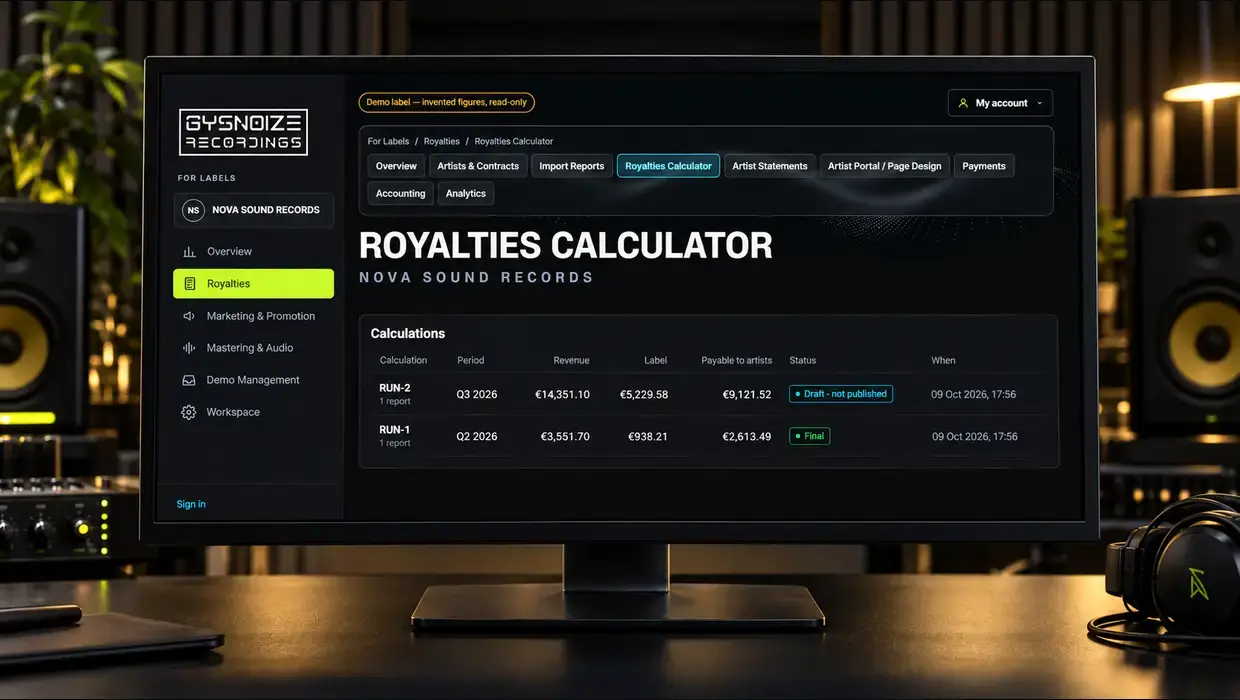
One of its parts is GYSNOIZE Royalties, music royalty accounting software built around the needs of independent record labels. It brings together artists, agreements, distributor reports, royalty calculations, statements and payment records, so that a label can handle them systematically. In a label workspace:
- Distributor reports are uploaded as CSV or Excel files; the label maps the columns and matches lines to its catalogue, and lines that do not match wait for a person to resolve them.
- The same report file cannot be imported twice.
- Artist, release and track agreements are applied, with recoupment of costs where the contract allows it.
- Amounts in another currency are converted with an exchange rate whose date and source are recorded.
- Each calculation run is reviewed by the label before it publishes PDF and CSV statements, with a traceable history.
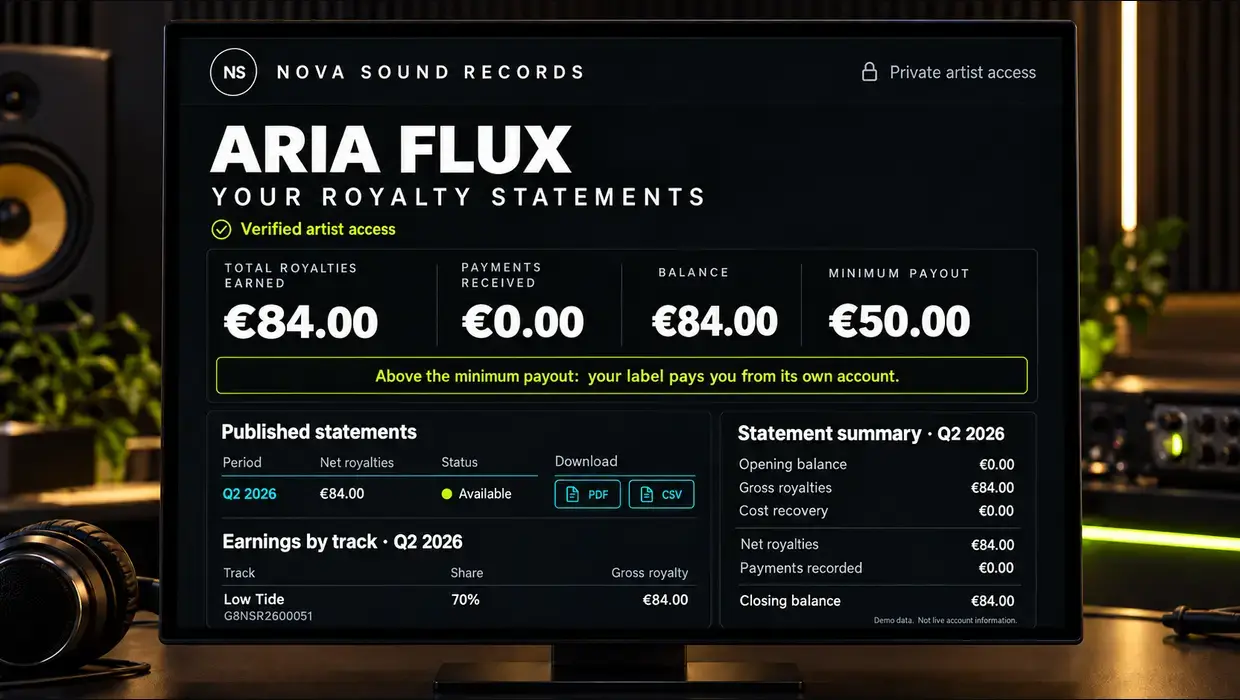
- Each artist can have a private page with their statements, earnings by track and payment history.
- The label records the payments it makes through its own bank or payment service.
A subscription, not a commission
GYSNOIZE Royalties is sold as a yearly subscription plan rather than as a percentage of the royalties processed. Each plan year has two limits, the number of statement lines and the amount of royalties calculated, and an upgrade is needed when either is passed. Current plans and prices are listed on the For Labels page.
No custody of royalty funds
GYSNOIZE Royalties is administrative and accounting software. It does not receive, hold or transfer the royalties owed to artists: the label pays its artists through its own bank or service, and the workspace records those payments. Labels remain responsible for their own financial obligations and for making payments.
Built around independent music businesses
The GYSNOIZE platform combines practical record label experience with software development. Its approach favours clear workflows, professional organisation and control over the business. The long-term aim is to help independent music businesses handle the administration around their creative work more efficiently.
Explore GYSNOIZE Royalties See plans and prices
Common music royalty accounting mistakes
Even experienced music businesses run into accounting problems. Knowing the common mistakes is an important step towards accuracy.
Mistake 1: Using a fixed streaming rate
A fixed per-stream estimate is no substitute for actual distributor revenue data. Different revenue sources, markets and agreements produce different results.
Mistake 2: Confusing gross and net revenue
Always identify the exact royalty base the contract requires.
Mistake 3: Applying the wrong royalty percentage
Artist agreements differ, and each percentage must be matched to the right contract and the eligible revenue.
Mistake 4: Importing the same statement twice
Duplicate reports inflate totals. Use controls that recognise imports that have already been processed.
Mistake 5: Ignoring corrections and negative adjustments
Reports may include reversals, corrections, refunds or negative amounts. These lines should not simply be discarded.
Mistake 6: Confusing recording and publishing income
Different music rights may be collected and administered through different systems. Do not merge unrelated royalty categories without a valid accounting basis.
Mistake 7: Confusing a royalty statement with a payment
A statement explains the amounts calculated or owed. A payment record documents a payment that was made. The two are not interchangeable.
Mistake 8: Failing to keep an audit trail
Labels should keep enough supporting information to understand and reproduce their calculations when needed. Good royalty accounting needs both correct calculations and reliable records.
How often should independent labels calculate royalties?
The right accounting schedule depends on the contracts and on when the financial information arrives. Some businesses calculate and report royalties quarterly, others follow different schedules; no single frequency applies to every artist agreement. Labels should set clear procedures for:
- Receiving distributor reports.
- Reviewing data quality.
- Calculating royalties.
- Preparing statements.
- Reviewing exceptions.
- Making payments where they are due.
- Recording completed payments.
- Carrying balances into the following accounting periods.
Consistency matters most. A clearly defined accounting process helps labels manage expectations and prepare statements more efficiently.
How to choose royalty management software
Before choosing royalty management software, an independent label should ask several practical questions.
- Does it read the distributor reports you receive? Import compatibility matters when you work with several revenue sources.
- Can it represent your actual contract terms? The system must be able to apply the royalty rules you agreed.
- Does it keep the source information? Every amount should remain traceable to the report it came from.
- Can statements be reviewed before they are final? A review step catches errors before statements reach artists.
- How are payments handled? Find out whether the software calculates royalties, records payments, makes payments, or a combination of these.
- How does pricing work? Look at subscription fees, transaction limits, catalogue limits and other conditions.
- Will it support your growth? A tool that works for a small catalogue should also cope with larger datasets and more complex requirements as the label develops.
Choosing the right software is more than comparing feature lists. It means understanding how the system fits the way your label actually does its accounting.
Frequently asked questions about music royalties
How do record labels calculate artist royalties?
Record labels generally determine the eligible revenue for each recording and calculate the artist's share according to the agreement. Deductions, recoupment and other contract terms may affect the amount payable.
How much do artists receive from record labels?
There is no universal percentage. The artist's share depends on the contract, the royalty base and any adjustments that apply.
How are Spotify streaming royalties calculated?
Spotify allocates royalties to the relevant rights holders through its streamshare system and its licensing arrangements. Artists receive their income through their rights holders and the contracts they have with them.
What is a music royalty statement?
A royalty statement is a financial report showing music earnings, the calculations applied, adjustments, and the amounts owed or paid for a given accounting period.
Can independent labels calculate royalties in Excel?
Yes. Spreadsheets work for royalty accounting, especially when the catalogue and the contracts are simple. Specialised software becomes more practical as transaction volumes and contract complexity grow.
What does recoupment mean in music royalties?
Recoupment generally means recovering qualifying advances or expenses from royalty earnings as the agreement allows.
What is royalty management software?
Royalty management software helps music businesses organise revenue reports, contracts, royalty calculations, statements and the related financial records.
Does GYSNOIZE Royalties distribute music to Spotify?
No. GYSNOIZE Royalties is royalty administration software, not a digital music distributor. It supports the financial administration around a label's music.
Does GYSNOIZE Royalties take a commission on artist earnings?
No. It is a yearly subscription, not a percentage of the royalties processed. Plan limits and prices are listed on the For Labels page.
The future of independent record label accounting
Today's independent music industry lets artists and labels work on an international scale. At the same time, music businesses face growing demands for financial organisation, transparency and consistency. Every new recording, artist agreement and reporting period adds information that must be managed accurately.
For many independent labels, relying only on manually maintained systems becomes harder as the catalogue grows. Professional royalty accounting software can bring more structure to the work while the label keeps responsibility for its financial decisions.
At GYSNOIZE Recordings, our experience as an independent label drives our interest in practical music business technology. We believe professional tools should help independent music businesses work more efficiently without compromising their creative freedom. Music remains at the centre of everything we do; technology should make the business around it easier.
Discover GYSNOIZE Royalties
Take a more organised approach to royalty administration. Explore GYSNOIZE Royalties and see how specialised software can support an independent label with royalty reporting, artist agreements, statements and payment records.
Independent Music. Professional Tools. Creative Freedom.
This article provides general educational information about music royalty accounting. Actual royalty calculations and payment obligations depend on the contracts, rights, reporting arrangements and laws that apply. It is not legal, accounting or tax advice.
About the author: GYSNOIZE Recordings is an independent record label founded in Italy in 2013 by GYSNOIZE, a music producer, DJ, composer and audio engineer. The label's work includes electronic music production, professional audio engineering and music technology development.